When the System Is Clear, Teams Move with Purpose
Most leaders have experienced the same pattern: progress depends too heavily on their presence, decisions stall when they are unavailable, and teams interpret the same instruction in different ways. These are structural signals. They indicate that clarity is not yet a property of the system.
This chapter sets out how clarity becomes structural rather than personal. It explains how expectations are externalised, how decision-rights are distributed, how alignment is maintained without repeated intervention, and how leaders prevent themselves from becoming bottlenecks. The focus is on the conditions that allow teams to act with confidence, consistency, and purpose.
Clear systems exist in many domains (see the Sidebar below). They differ in context but share the same mechanism: expectations are explicit, responses are defined, and behaviour is guided by structure rather than memory or personality. When these conditions are present, teams do not need to improvise. They know what to do, why it matters, and how to move together.
The sections that follow describe the core elements of clear leadership and the practices that sustain it. They provide a practical foundation for the thinking tools introduced in Chapter 3 and the communication disciplines set out in Chapter 4.
Clarity as your only responsibility
The primary task of leadership is to create clarity. Clarity of purpose. Clarity of direction. Clarity of expectations. Without clarity, teams fill the gaps with assumption. Assumption can be wrong and misalignment can occur. Misalignment becomes rework, frustration, and costly wasted effort.
Clarity is not a one off act. It is a continuous discipline.
How do you know when you have achieved it? When others demonstrate that they are clear by their actions.
Getting to clarity
When you ask a team member if they are clear on what is to be done, people rarely admit confusion because they do not want to look uninformed, they assume everyone else understands, they fear slowing the group down, and they think the leader expects a "yes".
But, the leader’s internal sense of clarity is irrelevant.
Clarity only exists when it is demonstrated by others. If others demonstrate clarity, you know that clarity has been established. Clarity is not what you say. Clarity is what others can reliably act on.
What you can do
After having discussed an issue and having imparted a number of points:
1. Replace "Is that clear" with "Show me how you understand this"
Ask for a playback, not a confirmation
- Ask: "Talk me through how you would explain this to someone else."
- Ask: "What would you do first based on this?"
- Ask: "What constraints matter most here?"
This turns clarity into something observable, not assumed. When their interpretation is played back, you can steer.
If they phrase things differently to you, that is fine. Steer on the substantial points.
2. Make clarity a shared artefact, not a spoken explanation
Clarity becomes objective when it is written down. Use short, structured artefacts: a one sentence purpose, three bullet expectations, definition of done, decision boundaries.
If it cannot be written simply, it is not yet clear.
3. Use the alignment test
Ask the team one-on-one to answer: what are we trying to achieve, what matters most, what we are not doing, who decides what.
If answers diverge, clarity is not present. This avoids the social pressure of saying "I do not understand".
4. Push clarity outward through decision-rights
Clarity scales when people understand their decision‑rights: what they own, what they can decide independently, when they must escalate, and the constraints they must operate within. Decision‑rights make authority explicit and predictable.
This removes the leader as the bottleneck and creates distributed clarity ownership.
5. Use examples and counter examples
People understand boundaries better through contrast. "A good version of this looks like…" and "A version that would not work is…". Relatable and clear examples remove ambiguity faster than abstract statements.
6. Make clarity testable through behaviour
Clarity is proven when decisions are consistent, priorities match the stated direction, people act without hesitation, and escalations reduce.
If these do not happen, clarity is not present.
7. Build a feedback loop into the system
Use a simple, repeatable OCAP-UMA loop: Observe → Capture data → Analyse data → Plan change → Update system → Measure effect → Adjust.
This prevents the leader from becoming the permanent clarity provider. If all staff are empowered to do this, the system becomes the mechanism for restoring clarity.
Why this works
Because it shifts clarity from internal to external, spoken to demonstrated, leader held to team held, momentary to continuous.
Clarity becomes a property of the system, not an ad-hoc performance by the leader.
An Example
Turning Clarity into a Shared Artefact
Imagine assigning a team to deliver a new internal workflow tool. Instead of explaining the work verbally and asking "Is that clear", create a shared artefact that everyone can see, reference, and challenge.
1. One sentence purpose
Purpose: Build a lightweight internal workflow tool that reduces manual handoffs and shortens cycle time for support requests.
2. Three bullet expectations
- The tool must reduce average handoff time by at least 20 percent.
- It must be simple enough for a non technical user to adopt without training.
- To support adoption, the tool must integrate cleanly with the existing ticketing system.
3. Definition of done
A working prototype is deployed to staging. Support leads validate the workflow end to end. Metrics for handoff time and error rate are visible. A short usage guide is published.
4. Decision boundaries
The team decides implementation details, sequencing, trade offs, UX flow. Leader decides scope changes, dependencies, risk tolerance. Non negotiables: must meet security standards and must not increase operational load.
How this creates real clarity
Because the artefact is written, the team can replay it, challenge it, ask questions without pressure, align decisions against it, and use it as a reference. Clarity becomes shared, not assumed.
What to do when getting to clarity is not working
Getting back on track
Even with a written artefact, clarity can fail. Detect and correct it.
1. Look for behavioural signals
Repeated questions, inconsistent decisions, rework, or different interpretations indicate missing clarity. These are system signals, not people problems.
2. Run the playback test
Ask: "Talk me through how you understand the purpose." Ask: "What would you do first?" Ask: "What trade offs matter most here?"
If answers diverge, or they are not forthcoming, clarity is not present.
It is not that "they have not understood", it is that clarity is yet to be established so the team can do their best work.
3. Tighten the artefact
Shorten the purpose. Simplify expectations. Make the definition of done more concrete. Sharpen decision boundaries.
If it cannot be written simply, it is not yet clear.
4. Use the system loop
Run OCAP-UMA.
Observe → Capture data → Analyse data → Plan change → Update system → Measure effect → Adjust.
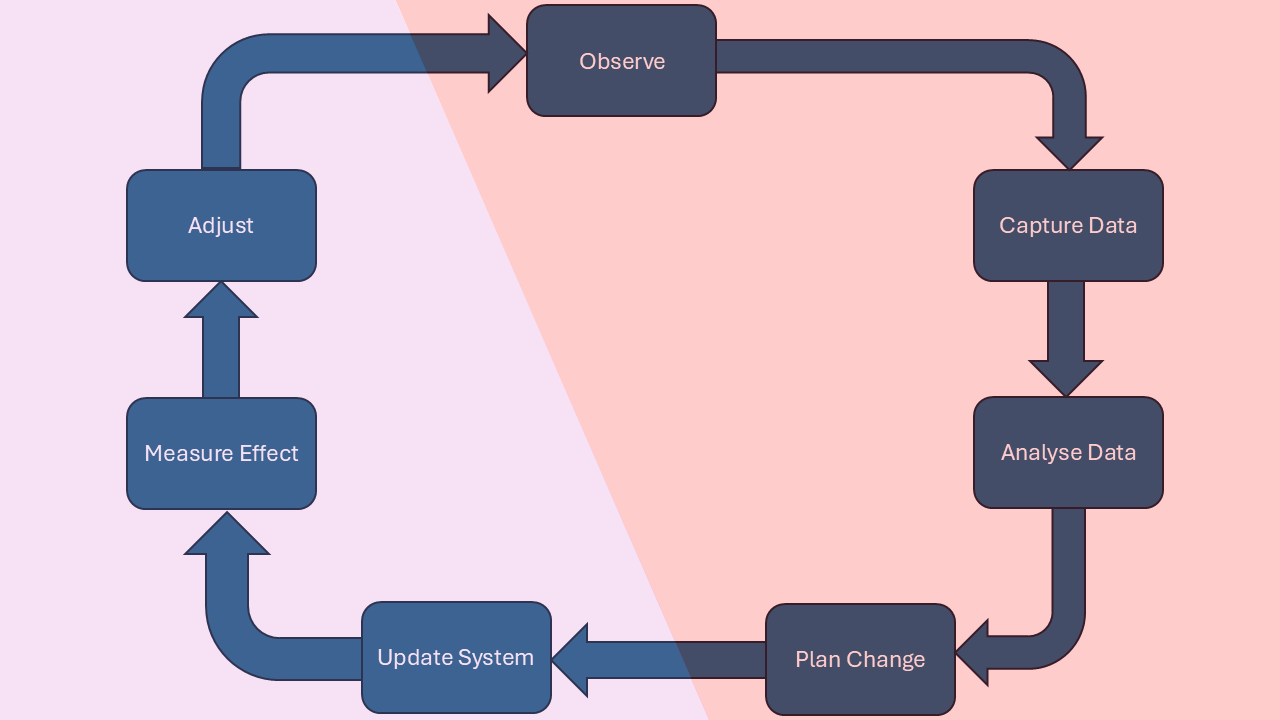
Just like the software you build, the system you use to deliver that software requires testing. You can do this through observation, data capture, analysis and planning. Once you have a plan for updating the system you can update it, measure what happened and adjust your response.
The diagram falls into two halves. The righthand side collects data and requires thinking about your unique context to improve any identified issues. The leftside involves affecting the system you currently have in place to apply your improvements.
Focussing on the system acknowledges that success or failure is due to the shared system.
Looking at how information flows through your system will tell you whether the bottleneck is you. For example, for others to reach a decision, must the information that is input to that decision come to you? does it need to? Could this information go to someone else once they are informed of your expectations?
5. If clarity still fails, check the root cause
Use the "5 Whys":
- Why was the work misunderstood?
- Why did that occur?
- Why was the artefact insufficient?
- Why did the team interpret it differently?
- Why did the system allow ambiguity to persist?
This will reveal structural issues.
This is not to assign blame. The focus should be on the system. Given the system as it is, why did the team interpret the communication differently? Do not focus on the people, focus on the system you are all working within.
Clarity is not what is said
Clarity is not what you say. Clarity is what the team can reliably act on. Clarity is what the team understands to do their job.
Intention and behaviour must match
Organisations do not behave according to what leaders intend. They behave according to what leaders tolerate, reward, and repeat.
Does your part of the organisation behave as intended? If not, the issue is rarely the people. It is the system. Leadership becomes a thinking discipline rather than a performance.
Structure over personality
Strong organisations rely on sound structure, not heroic individuals. Structure determines decisions, information flow, coordination, and scale. When structure is weak, personality fills the gaps, creating inconsistency, dependency, and fragility.
Judgement as a practice
Judgement is a skill developed through deliberate thinking, reflection, and exposure to consequence. Judgement must be supported through clear principles, stable decision patterns, tools for reducing ambiguity, and mechanisms for learning from outcomes.
Stepping back when the system fails
When things do not go well, the first move is observation, not blame. Why did things not go well?
Treat failure as a signal about the system. Ask: what occurred, what conditions were present, which parts of the system were involved.
If the same response is carried out, the same outcome is likely. New thinking, grounded in data, is required. Use OCAP-UMA and iterate until the issue is resolved. Techniques like the 5 Whys help trace systemic causes without blaming individuals.
Reliability over speed
Speed without clarity creates chaos. You create activity but little progress.
Reliability creates confidence and trust. Trust creates pace.
Prioritise predictable decisions, stable communication, consistent expectations, and calm responses to pressure.
This is steadiness, not slowness. It is reproducable.
A system that scales
The system scales with the organisation. It does not rely on the leader being present in every room. It creates conditions where clarity, judgement, and reliability propagate through the system itself.
Alignment without theatrics
Leadership does not require drama. It requires alignment. Alignment is created through clear goals, shared understanding, consistent behaviour, and transparent reasoning.
Alignment should be an outcome of the system.
When alignment becomes a property of the system rather than the leader, the organisation moves with steadiness. But when clarity is concentrated in one person, the system begins to slow. This is where bottlenecks form.
Creating Clarity Without Becoming the Bottleneck
When you lead, people naturally queue at your door. Not because they cannot think for themselves, but because the system quietly trains them to wait for your nod. Before long, every decision, large or small, flows through you. That is how bottlenecks form. Not through incompetence, but through habit.
There are two parts to breaking that habit. The first is mechanical.
Removing yourself from every decision
To achieve this you need to make expectations visible, decision-rights explicit, and information easy to reach. This removes the need for people to come back to you for clarity.
A simple example makes the point. Imagine a team unsure whether they can adjust a delivery plan. If the boundaries are clear, they decide. If the reasoning behind past decisions is visible, they decide well. If neither is true, the work lands back on your desk.
Training everyone with Thinking Tools
The second is cognitive. You use thinking tools that stop the system drifting back into ambiguity once you step out of the centre. This requires everyone to be aware of how to use the Thinking Tools so that your colleagues can respond appropriately.
Removing yourself as the bottleneck and teaching everyone the thinking tools are two halves of the same move. The first changes the structure. The other changes the behaviour of your colleagues who work through that structure.
The Thinking Tools themselves are introduced fully in Chapter 3. In this chapter, we stay focused on the structural side of clarity: expectations, decision‑rights, information flow, and the rhythms that prevent ambiguity from returning. These create the space for autonomy. The Thinking Tools in the next chapter show you how to fill that space with sound judgement, shared mental models, and consistent decision‑making by your colleagues at the edge.
When you step out of the centre, the team suddenly has space to act. But space alone is not enough. Without shared thinking habits, people fall back to fill that space with guesswork, old assumptions, or whatever the last leader preferred. The system slips back to dependency.
When everyone practises the thinking tools, teams develop a common way of seeing problems, framing decisions and spotting ambiguity early. This means the quality of decisions at the edge rises to match the quality you used to provide at the centre. Only now, decision making is scaled.
Removing yourself is mechanical; there is no need for you to be in every decision. The thinking tools ensure the decisions made without you are sound. The first creates the room. The second fills it with distributed colleague competence.
Removing yourself from every decision
Before getting into the practical steps of how to remove yourself from being a bottleneck, it helps to see the pattern they all address. Picture a team facing a routine decision, something well within their ability. Instead of acting, they pause. Someone asks for your view. Someone else waits to see what you prefer. The work slows, not because the decision is difficult, but because the system has taught people to look upward before moving.
Points 1 to 7 exist to help you break that reflex. They give people the confidence, authority and information to act without circling back to you. They turn hesitation into momentum by removing the uncertainty that causes teams to stall in the first place. In doing this, you remove yourself as the bottleneck.
These seven steps are a change to the structure so teams do not have to look up. The thinking tools are used by everyone so the system stays healthy.
1. Make expectations explicit, not implicit
Most bottlenecks form because people are unsure what "good" looks like.
Define:
- What decisions teams own
- What constraints they must operate within
- What outcomes matter most
- What "done" means in your environment
When expectations are explicit, people stop waiting for permission.
Doing this will require time from you but that time is an investment. Once expectations are explicit and they are understood, your colleagues will have the confidence to decide for themselves. And you will know they will do this in a way that works for you and everyone else.
If you think you do not have time to do this, what is the alternative? Carry on with you as the bottleneck. Surely, there is an alternative? There is. Applying these seven points to not be the bottleneck.
2. Push decisions to the leaves by defining decision-rights
This is the most powerful structural tool.
Create a simple, visible map:
- Leaders decide: strategy, priorities, constraints
- Teams decide: execution, sequencing, trade offs
- Individuals decide: local judgement calls, immediate actions
The rule is:
If the decision is closest to the work, it belongs to the team.
This removes 70–80 percent of unnecessary escalation.
How to Push Decisions to the Leaves
1. Define the boundaries- Budget
- Risk tolerance
- Time constraints
- Non negotiables
"If it fits inside the boundary, you decide."
3. Require visibility, not permission
Teams share decisions, but do not wait for approval.
4. Review outcomes, not choices
You coach the system, not the moment.
The principle that makes this work
Clarity is a property of the system, not the leader. When the system is clear, people do not need to ask. This is how you scale your leadership without becoming the bottleneck or having to be in every meeting.3. Replace "ask me" with "use this"
If people must ask you for clarity, the system is failing. Provide:
- Principles (how we decide)
- Guardrails (what must not be violated)
- Patterns (how similar decisions were made before)
- Templates (how to structure a decision)
This turns your judgement into a reusable asset.
4. Use "leader as context setter," not "leader as answer giver"
When someone brings a decision to you, respond with:
- "What options have you considered?"
- "What constraints matter here?"
- "What outcome are you optimising for?"
- "What does the system tell you to do?"
You are training the system, not solving the problem.
5. Build a rhythm of clarity
Clarity is not a one off act. It is a cadence.
Use:
- Weekly priorities
- Monthly alignment reviews
- Quarterly strategy resets
When the rhythm is predictable, people stop seeking ad hoc clarification.
6. Make information flow by default, not by request
Bottlenecks form when leaders are the only ones who see the full picture.
Fix this by:
- Publishing decisions
- Sharing reasoning
- Making metrics visible
- Making constraints explicit
When information flows, decisions flow.
7. Use the system loop to correct drift
When clarity breaks down, do not jump in with answers. With your colleagues, run the OCAP-UMA loop: Observe → Capture data → Analyse data → Plan change → Update system → Measure effect → Adjust.
This prevents you from becoming the emergency clarity provider.
Thinking Tools as a Discipline
Thinking tools are practised. Over time, they shape judgement, and judgement shapes the organisation. This chapter forms the bridge between the leadership operating system and the next stage of the guide that introduces you to the Thinking Tools.
Conclusion
Clarity is a structural property, not a personal trait. When expectations are explicit, simple, and shared, people stop guessing and start acting with confidence. When signals are vague, the system slows, drifts, and strains under the weight of interpretation.
The practical lesson is straightforward: clarity only exists when it shows up in what people do. A leader feeling clear is irrelevant. A team acting in alignment is the only proof that clarity has been established. This shifts leadership away from personality and towards structure.
Ambiguity is not a character flaw. It is a system signal. When people hesitate, diverge, or ask the same questions repeatedly, the system is telling you that something is unclear. Treating these signals as data gives you leverage. You stop trying to fix individuals and start improving the conditions they are working within.
Clarity scales only when it is externalised. Written artefacts, examples, boundaries, and feedback loops turn clarity into something the organisation can hold without the leader being present. This is what creates steadiness: not speed, not heroics, but a calm, repeatable system that makes the right behaviour the natural behaviour.
This is the foundation of the Leadership OS.
The next chapter introduces the thinking tools that help leaders work deliberately with ambiguity, assumptions, decisions, systems, noise, momentum, and judgement. These tools turn clarity from an aspiration into a daily discipline.
Chapter 3 – Engineering Practise: Thinking Tools
Table of Contents
- When the System Is Clear, Teams Move with Purpose
- Clarity as your only responsibility
- Getting to clarity
- What you can do
- 1. Replace "Is that clear" with "Show me how you understand this"
- 2. Make clarity a shared artefact, not a spoken explanation
- 3. Use the alignment test
- 4. Push clarity outward through decision-rights
- 5. Use examples and counter examples
- 6. Make clarity testable through behaviour
- 7. Build a feedback loop into the system
- Why this works
- An Example
- What to do when getting to clarity is not working
- Creating Clarity Without Becoming the Bottleneck
- Removing yourself from every decision
- Training everyone with Thinking Tools
- Removing yourself from every decision
- 1. Make expectations explicit, not implicit
- 2. Push decisions to the leaves by defining decision-rights
- 3. Replace "ask me" with "use this"
- 4. Use "leader as context setter," not "leader as answer giver"
- 5. Build a rhythm of clarity
- 6. Make information flow by default, not by request
- 7. Use the system loop to correct drift
- Thinking Tools as a Discipline
- Conclusion
- Table of Contents
- Further Reading
Further Reading
Toyota Production System (TPS)
-
Liker, Jeffrey K. The Toyota Way: 14 Management Principles from the World's Greatest Manufacturer. McGraw‑Hill, 2004.
https://www.toyota-global.com/company/vision_philosophy/toyota_production_system/ -
Ohno, Taiichi. Toyota Production System: Beyond Large‑Scale Production.
https://www.lean.org/explore-lean/what-is-lean/
US Navy SEAL Teams – Mission Clarity & Communication
-
Four Concepts to push your communication to the next level
https://navyseals.com/3846/team-life-mission-3-communication/ -
US Navy SEALs Training & Communication Doctrine (Naval Special Warfare)
https://www.navy.com/seals
Aviation Checklists – Reliability Through Procedure
- Federal Aviation Administration (FAA) – Pilot’s Handbook of Aeronautical
Knowledge, Chapter on Checklists
https://www.faa.gov/regulations_policies/handbooks_manuals/aviation/phak
Hospital SBAR Protocols – Structured Clinical Communication
-
Institute for Healthcare Improvement (IHI) – SBAR Technique
http://www.ihi.org/resources/Pages/Tools/SBARTechniqueforCommunicationASituationalBriefingModel.aspx -
NHS England – SBAR Communication Training... https://learninghub.nhs.uk/catalogue/SBAR/about
-
Randmaa, M, et. al. SBAR improves communication and safety climate... https://bmjopen.bmj.com/content/4/1/e004268